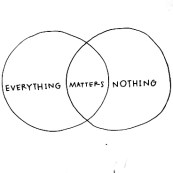
 Being software engineers, we use null as a value that is unavailable, unassigned, unknown, or inapplicable. It is neither a zero nor a blank space. A database designer uses a null to indicate a data value that does not exist in the database. A programmer uses a null pointer for an uninitialized, undefined, empty or meaningless value. It is believed that a null reference is probably the worst mistake made in programming. I will argue otherwise.
The origin of the word ‘null’ is not completely known. It is believed that the word is derived from the Latin word ‘nullus’, which is further a combination of the words ‘ne’ and ‘ullus’ meaning ‘not’ and ‘any’ respectively. There is also an argument that the word null is derived from the Latin word ‘nihil’ which means ‘nothing’. If we take the utilitarian path here, null seems closer to nil than signify the negation of anything. The origin or significance of null, however is not the primary question, since different programming languages have used null, nil and nothing in their syntax to signify a data abstraction of something unassigned.
The interesting question here is how null has its deep roots embedded in nihilistic philosophies and how the same can be used to answer the dilemmas technology faces today or will face in the future.
Nihilism suggests the negation of one or more reputedly meaningful aspects of life. Or in simple words, Nihilism says that it is wrong to say something exists. This is similar to leaving a value unassigned in a database or leaving a variable uninitialized in a computer program. I had argued in an old article that softwares are progressively replicating the real world and will continue to do so, until at a point it will surpass the capabilities of real world. Then, the next moral ambiguity that we as programmers will face is not what is to be done, but what should not be done with the power we will have at hand. The moral threads of nihilism may have an answer to such dilemmas.
Nihilism, when looked at as a rejection of such meaning or meta-narrative seems to be in many ways similar to Buddhism. While Buddhism is much more deep, profound (and confusing), its rejection of despair and desire follows the tetralemma which boils down to a logical construct something like –
- It is incorrect to say something exists. X (affirmation)
- It is incorrect to say that something does not exist. ¬X (negation)
- It is incorrect to say that something both exists and does not exist. X∧¬X (both)
- It is incorrect to say that something neither exists nor does not exist. ¬(X∨¬X) (neither)
It is quite obvious that if we stop our argument at the first step, we reach nihilism. Buddhism on the other hand rejects nihilism as well as relativism in the aforementioned subsequent steps. There is a general belief that nihilism breeds alienation and that this alienation is dangerous for society in general. While this fear of nihilism is quite widespread, let me construct a counter-argument here.
Unlike Buddhism, Nihilistic rejection is not the general rejection of everything. Nihilism, similar to the other prominent philosophies which were born and became important in the nineteenth century – like Marxism, Freudianism and Darwinism – is strongly based on critical thinking and an objective scientific analysis of the question at hand. Like the null value in a database or the null assigned to a variable in a computer program, a nihilist experiences much greater flexibility and freedom. He is not only at a higher state of thinking; he is at a higher state of being. A nihilist does not close your eyes. Instead, it enables greater far sightedness. No wonder Camus’ Rebel and Nietzsche’s Superman are both nihilists.
It must be noted here that never before in history have human lives changed so drastically and profoundly by science and technology. In modern times, the ones to possess the deepest understanding of nature and the human condition are the scientists and technocrats; not politicians, philosophers, businessmen or economists. While science is intrinsically nihilistic, technology is not. Stephen Hawking had once said that “The human race is just a chemical scum on a moderate-sized planet, orbiting around a very average star in the outer suburb of one among hundreds of billions of galaxies.” A general consensus among scientists is that human life is meaningless. To the question “Where am I going?”, the scientist will reply, “To oblivion. To nonexistence.”
Technology on the other hand, is not merely means. According to Heidegger, “technology is a way of revealing.” Technology, unlike science is short sighted, and because of this very nature, it tries to seek meaning in everything. Null is the most common entity across databases. Calling it a mistake is an affirmation to this fallacy. The loopholes in a computer program is revealed through null. Similarly the loopholes in a society is revealed when seen through through the nihilist lens. Handling null being considered dangerous in programming circuits is similar to how nihilism is seen in the post WW2 era.
However, based on the argument that the future of our world will be determined not by what technology does, but by what we stop technology from doing – bringing back the nihilist perspective into technology – the birth of a rebel or the rise of a superman – is very important.


Speak up!